
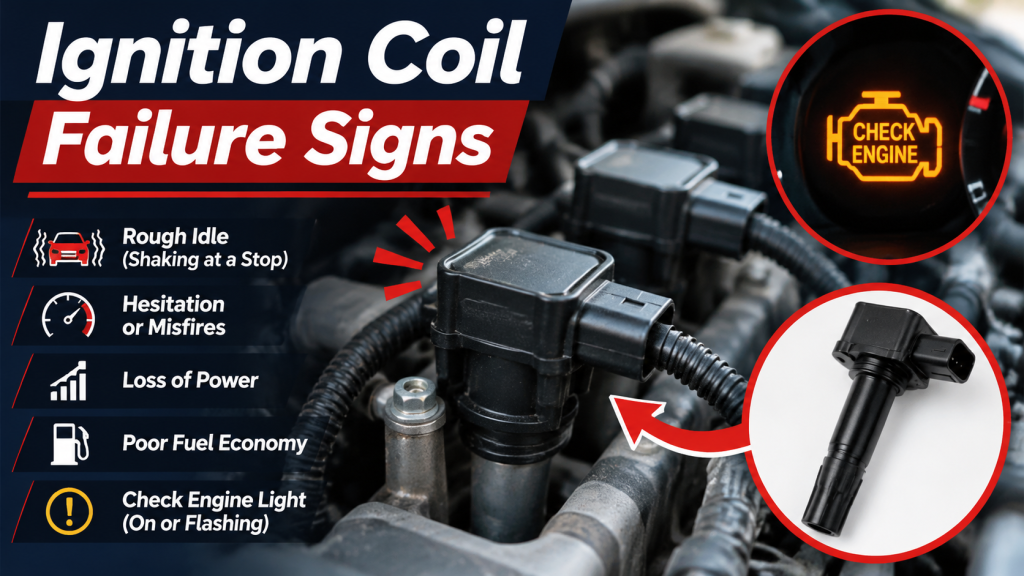
A car that shakes at a stoplight, hesitates when you press the gas or flashes its check engine light is telling you something. One of the most common causes of those symptoms is a failing ignition coil. The coil is a small part, but when it stops doing its job, a cylinder in the engine can stop firing, and the whole car feels wrong. This guide explains what an ignition coil does, how a bad one causes misfires and rough running, the signs to watch for, what to do when the check engine light flashes and how the repair usually works. If you are searching for ignition coil replacement in Marietta, GA, here is a clear overview before you make a call.
What an Ignition Coil Does
Gasoline engines need a spark to ignite the mix of air and fuel in each cylinder. The car’s battery provides only about twelve volts, far too little to jump the gap at the tip of a spark plug. The ignition coil is a kind of transformer that takes the low voltage and boosts it to the very high voltage needed to create a strong spark. The engine computer decides when each coil should fire, and the spark plug delivers the spark into the cylinder.
Older cars often had a single coil and a distributor that sent voltage to each plug through wires. Most modern cars use coil on plug or coil pack designs, with one coil for each cylinder or one for each pair. Your owner’s manual or a technician can tell you what your car uses.
How a Bad Coil Causes Misfires
When a coil is weak or has failed, the spark in its cylinder is weak or missing. The fuel and air in that cylinder do not burn properly, and that is what is called a misfire. The engine loses the power that cylinder should have produced, and the rotation of the engine becomes uneven. You may feel it as a shake, a stumble or a drop in power. The unburned fuel that passes through the cylinder can also cause other problems down the line, which is why misfires are worth taking seriously.
Common Signs of Ignition Coil Failure
- Rough idle. The engine shakes or shudders when the car is stopped, and the tachometer may bounce.
- Misfires. A stumbling, hesitating or jerking feeling, especially under acceleration.
- Check engine light. A steady light often stores a misfire code. A flashing light is more urgent, as explained below.
- Loss of power. The car feels sluggish, especially going uphill or when passing.
- Poor fuel economy. Misfires waste fuel.
- Hard starting. The engine cranks longer than usual or does not start smoothly.
- Stalling. The engine may die at idle or when slowing down.
- Fuel smell from the exhaust. Unburned fuel leaving the engine can be noticeable.
- Backfiring or popping sounds. These may come from the exhaust.
- Failed emissions test.
These signs can also come from other problems, including worn spark plugs, fuel delivery issues, vacuum leaks and sensor failures, so a proper diagnosis is important.
What a Flashing Check Engine Light Means
A solid check engine light tells you the car has detected a problem and stored a code. A flashing light usually means something more urgent, often a misfire severe enough to risk damage to the catalytic converter, which is an expensive part of the exhaust system. If your light is flashing:
- Ease off the accelerator and avoid hard acceleration or heavy loads.
- Get to a safe place and stop driving as soon as reasonably possible.
- Have the car checked promptly, or ask for a tow if it is running very badly.
- Check your owner’s manual, which explains what the light means for your vehicle.
Do not ignore a flashing light and carry on with your day. A short delay can turn a coil replacement into a much larger repair.
Why Do Ignition Coils Fail?
- Age and heat. Coils sit in a hot engine bay, and heat cycles slowly break down their insulation and windings.
- Worn spark plugs. When a plug wears, the gap widens and the coil has to work harder to jump it, which can shorten its life.
- Moisture and oil. Oil leaking into the spark plug wells or water getting in can damage coils and boots.
- Vibration. Engine vibration can loosen connections over time.
- Electrical problems. A weak battery or charging problem can strain the ignition system.
- Poor quality parts. Some replacement parts do not hold up as well as others.
Ignition Coil, Spark Plug or Something Else?
Misfire symptoms are tricky. A bad coil, a worn spark plug, a failing injector or an air leak can all feel almost the same. Technicians do not guess. Here is how they usually figure it out:
- Scan for codes. A misfire code often names the cylinder, such as a misfire on a specific cylinder, which points the technician to the right area.
- Inspect the coil and plug. They check for cracks, burn marks, oil, corrosion or a damaged boot.
- Swap parts between cylinders. Moving a suspect coil to another cylinder and seeing whether the misfire follows it is a common test.
- Test the spark plugs and the gap.
- Check other systems, such as fuel injectors, compression and sensors, when needed.
Replacing a coil without finding the cause can leave the real problem in place, so diagnosis comes first. If you are the type who wants to keep a car running smoothly without a lot of drama, our article on the no fuss way to stay road ready is a good place to start for regular upkeep.
Ignition Coil and Spark Plug Maintenance
Coils and plugs work as a team, so maintenance of one helps the other. Spark plugs wear out on a schedule that depends on the type of plug and your engine. Your owner’s manual lists the interval for your vehicle. Replacing plugs on time puts less strain on the coils. If one coil has failed and the plugs are due or old, a technician may suggest replacing them at the same time, because much of the work overlaps. Whether to replace just the failed coil or all of them depends on the car, the age of the parts and what the technician finds. Ask for a clear explanation.
What Ignition Coil Replacement Involves
- Diagnosis. The technician confirms which coil is failing and checks for other causes.
- Access. On many engines, coils sit on top and are easy to reach. On others, parts of the intake or covers must be removed first.
- Removal. The electrical connector is released and the coil is lifted from the spark plug well.
- Inspection of the plug and well. The technician looks for oil, damage or wear and replaces plugs if needed.
- Installation. The new coil is seated properly and the connector is secured.
- Clearing codes and testing. The technician clears the stored codes and tests the car to confirm the misfire is gone.
The engine should be cool before anyone works on it, since engine parts and the exhaust get very hot. Ignition systems also carry high voltage, so this is not the safest job to improvise. Disconnecting or touching parts while the engine runs can cause a painful shock.
Can a Mobile Mechanic Replace Ignition Coils?
Very often, yes. A mobile mechanic can come to your home or workplace in Marietta, read the codes, test the system and replace a failed coil or spark plugs on site. It is a repair that many vehicles allow in a driveway. Some engines make it harder, with coils buried under other parts or issues that go beyond the ignition system, such as damaged wiring, fuel problems or internal engine trouble. In those cases, the work may need more time or a shop, and a good technician will tell you so up front. Our post about one system that keeps causing problems is worth a read if a recurring issue has you stuck in a cycle of repairs.
How to Reduce Your Risk of Coil Problems
- Follow the spark plug schedule in your owner’s manual.
- Fix oil leaks, especially around the valve cover and spark plug wells.
- Do not ignore a check engine light. Early attention keeps repairs smaller.
- Keep the battery and charging system healthy.
- Use quality replacement parts that suit your vehicle.
- Do not keep driving with a flashing light.
- Keep up with general maintenance, including air filters and fluids.
When to Stop Driving
- The check engine light is flashing and the car runs rough.
- The engine shakes badly, loses power or stalls repeatedly.
- You smell fuel or burning, or see smoke.
- Any warning light for oil pressure or temperature appears.
In those situations, pull over safely and get help rather than trying to push on.
Quick Summary
- Ignition coils create the spark that makes the engine run.
- A failing coil causes misfires, rough idle, hesitation and a check engine light.
- A flashing light means act quickly to avoid further damage.
- Diagnosis comes first, since plugs, injectors and other parts can cause similar symptoms.
- Replacement can often be done at your home, though some engines need a shop.
A smooth running engine starts with a strong spark. If your car is stumbling or the check engine light is on, visit the Mobile Mechanic Pros of Marietta homepage to learn more, or contact us to schedule a visit.